
Standing Equine MRI Scanning
Advanced Lameness Diagnosis Without General Anesthesia
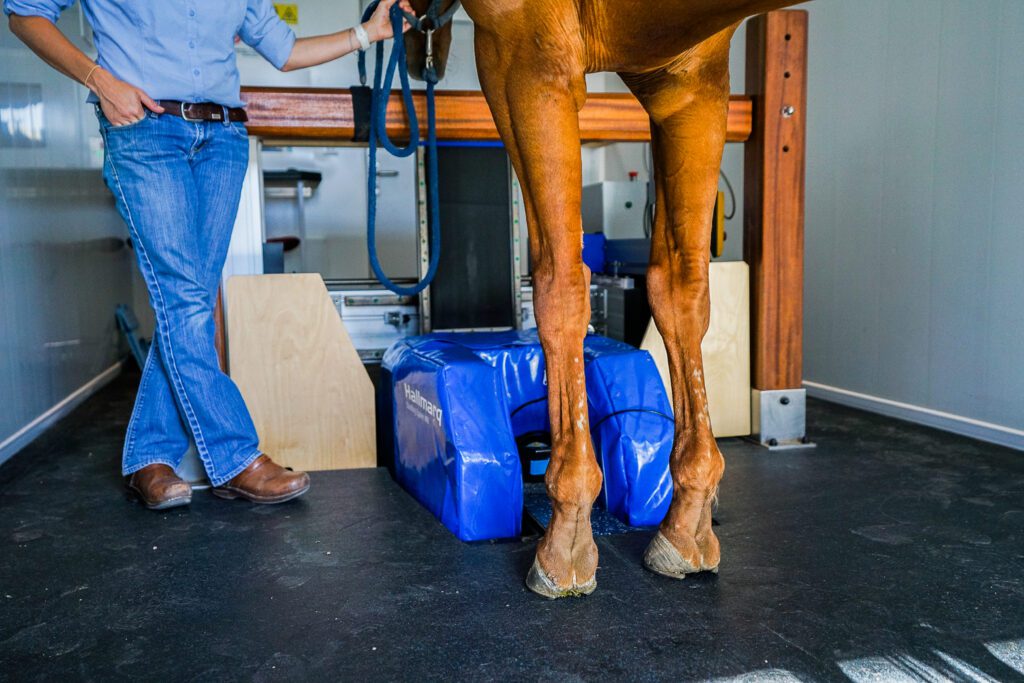
At Cave Creek Equine® Sports Medicine & Surgery, we offer Hallmarq™ Standing Equine MRI, a state-of-the-art imaging technique that allows us to diagnose subtle causes of lameness safely and accurately, without the need for general anesthesia.
This advanced technology helps our veterinarians pinpoint injuries involving bones, joints, tendons, and ligaments that may not appear on X-rays or ultrasound.
Magnetic Resonance Imaging (MRI) uses magnetic fields and radio waves to create detailed, cross-sectional images of tissues inside the body.
Our standing MRI system allows the horse to remain upright under light sedation while the lower limb is scanned. This means there’s no need for general anesthesia — reducing risks, recovery time, and cost.
During a standing MRI, we can capture clear images of:
Standing MRI has become an invaluable diagnostic tool for equine lameness because it combines detailed imaging with enhanced safety.
Key Benefits:
Standing MRI is especially helpful when other imaging methods, such as X-rays or ultrasound, are inconclusive.
Our veterinarians commonly recommend this advanced imaging for:
We want your horse’s MRI experience to be as safe and stress-free as possible. Here’s what to expect:
Is the procedure safe?
Yes. Because it’s performed under light sedation with no general anesthesia, standing MRI is a very safe diagnostic option.
Will my horse need to stay overnight?
Most horses go home the same day. In some cases, we may recommend an overnight stay for convenience or observation.
How long does it take to get results?
MRI scans are reviewed by our veterinarians, and results are typically available within a few days.
Can you scan both front limbs?
Yes, although each limb is scanned separately. Our staff will help you determine what’s needed based on your horse’s lameness evaluation.
Standing MRI often provides answers that other imaging methods can’t. By revealing subtle tendon, ligament, or bone changes, we can diagnose conditions earlier — leading to faster, more successful treatment outcomes.
Ready to learn more or schedule a standing MRI?
Our experienced team is here to answer your questions and guide you through the process.
We welcome both horse owners and referring veterinarians. If you’d like to discuss a case, please call our office to consult with our veterinary team.
623-581-5508